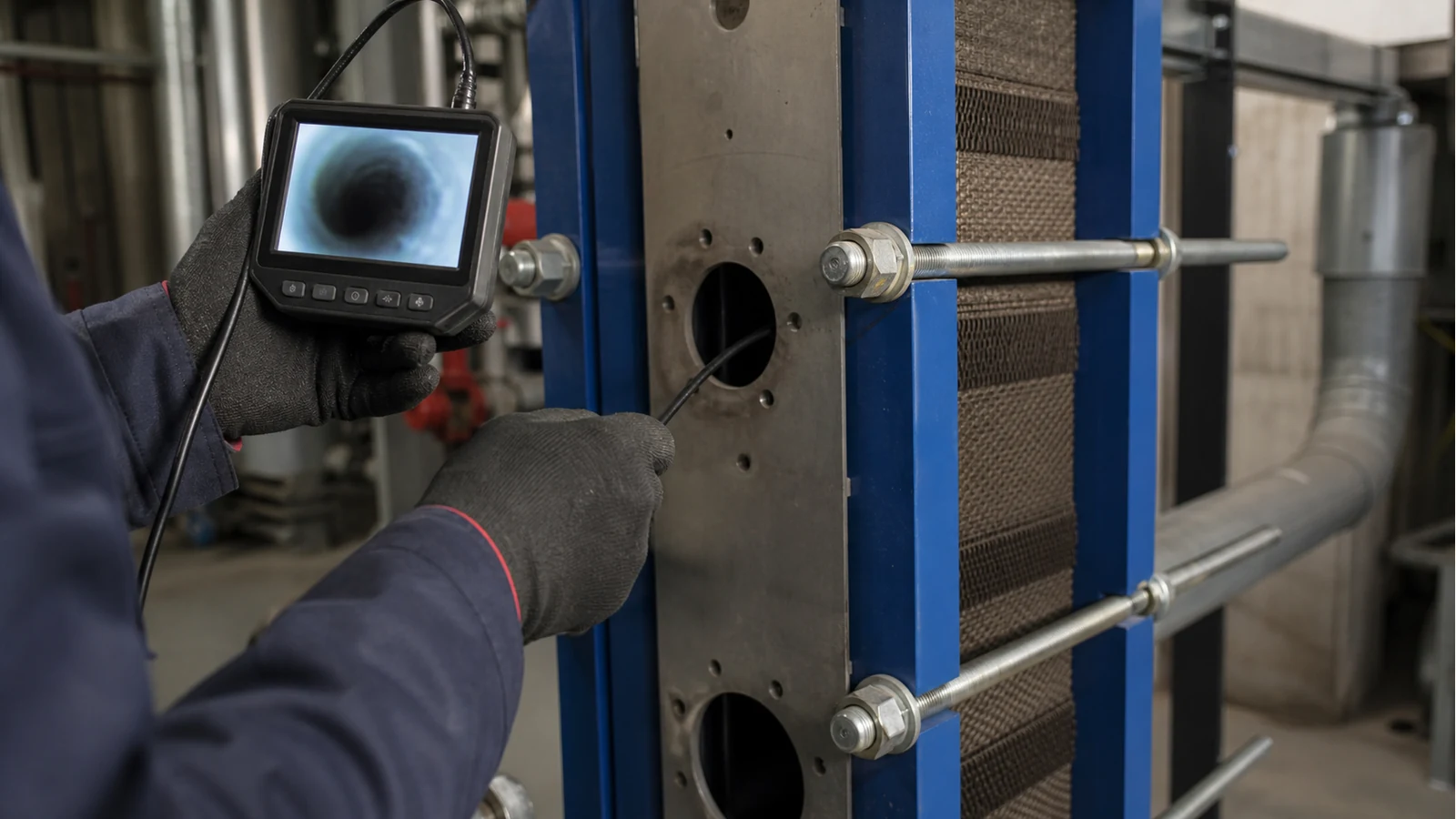
Heat Exchanger Inspection Camera Uk
Direct answer: a heat exchanger inspection camera needs a steerable or side-looking view when the surface you must assess is on a passage wall rather than straight ahead. For a simple flue glance with a clear line of sight, a straight fixed camera may be enough.
Start with the access, not the screen
The common buying mistake is to compare screens and headline resolution before proving the probe can enter the exchanger path. Current HVAC selection guidance says access bore and probe diameter are the first filter, with articulation added when the inspection target is off-axis, such as heat exchanger passage walls. See the practical diameter and articulation notes in this HVAC borescope selection guide.
For a UK plant-room job, measure the smallest entry point, note the depth you need to reach, then decide whether you need to look along the passage or into the side wall. If the wall surface is the point of the inspection, steering earns its keep. If the job is a direct visual check through a large opening, steering can add cost and another wear point without adding much information.
A field decision ladder
- Measure entry: confirm the real opening, including any sleeve, burr or offset that narrows the path.
- Map the view: decide whether the evidence is straight ahead, sideways, or around a bend.
- Check pushability: a short semi-rigid cable can be easier to control in a shallow exchanger path than a long soft cable that buckles.
- Confirm recording: if a client, insurer or maintenance file needs proof, a live-only view is weak evidence.
- Stop at the limit: if the probe cannot enter without force, use a smaller tool or another access point.
What a camera can and cannot conclude
A borescope can document visible fouling, corrosion, deformation or crack-like indications. It cannot certify that a heat exchanger is safe. The same HVAC guidance warns that a clean visual does not replace combustion analysis or pressure testing. Treat the image as one input in the diagnostic file, not the final verdict.
That distinction matters commercially. A clear photo can justify a recommendation, reduce argument about hidden conditions, and support a follow-up test. It should not be written up as a safety pass unless the relevant testing regime has also been completed by a competent person.
Evidence workflow for UK reports
For ventilation hygiene and building-services work, photographic evidence is already a normal expectation in many workflows. BESA's TR19-related guidance discusses visual inspection and photographic documentation in duct cleaning practice; the same discipline is useful when a heat exchanger finding must be explained to a client. The source context is here: BESA duct cleaning best practice.
Capture a wide context shot first, then the internal close-up, then a second shot after repositioning. Label the file in your job notes with asset, access point, orientation and whether the view was straight, side-view or steered. This keeps the photo useful after the person who took it has left site.
When not to pay for articulation
Do not buy steering just because it sounds professional. If your routine work is open duct runs, large inspection hatches, or exchanger checks where the target surface is visible straight ahead, a simpler camera may be quicker and more robust. If your work regularly involves passage walls, offset cracks, or looking back at an unseen face, steering changes the job from guesswork to controlled viewing.
For probe size, reach and steering, the safest buying method is still to match the camera to the task rather than chase the longest or most heavily advertised specification. QBH's buying guide makes that same job-first point: match probe size, reach and steering to the job.
Bottom line
Proceed with a steerable heat exchanger inspection camera when the access accepts the probe, the target surface is off-axis, and the finding needs to be documented. Choose a simpler camera when the view is direct. Pause and change method when visual evidence would be used as a safety conclusion without the supporting tests.