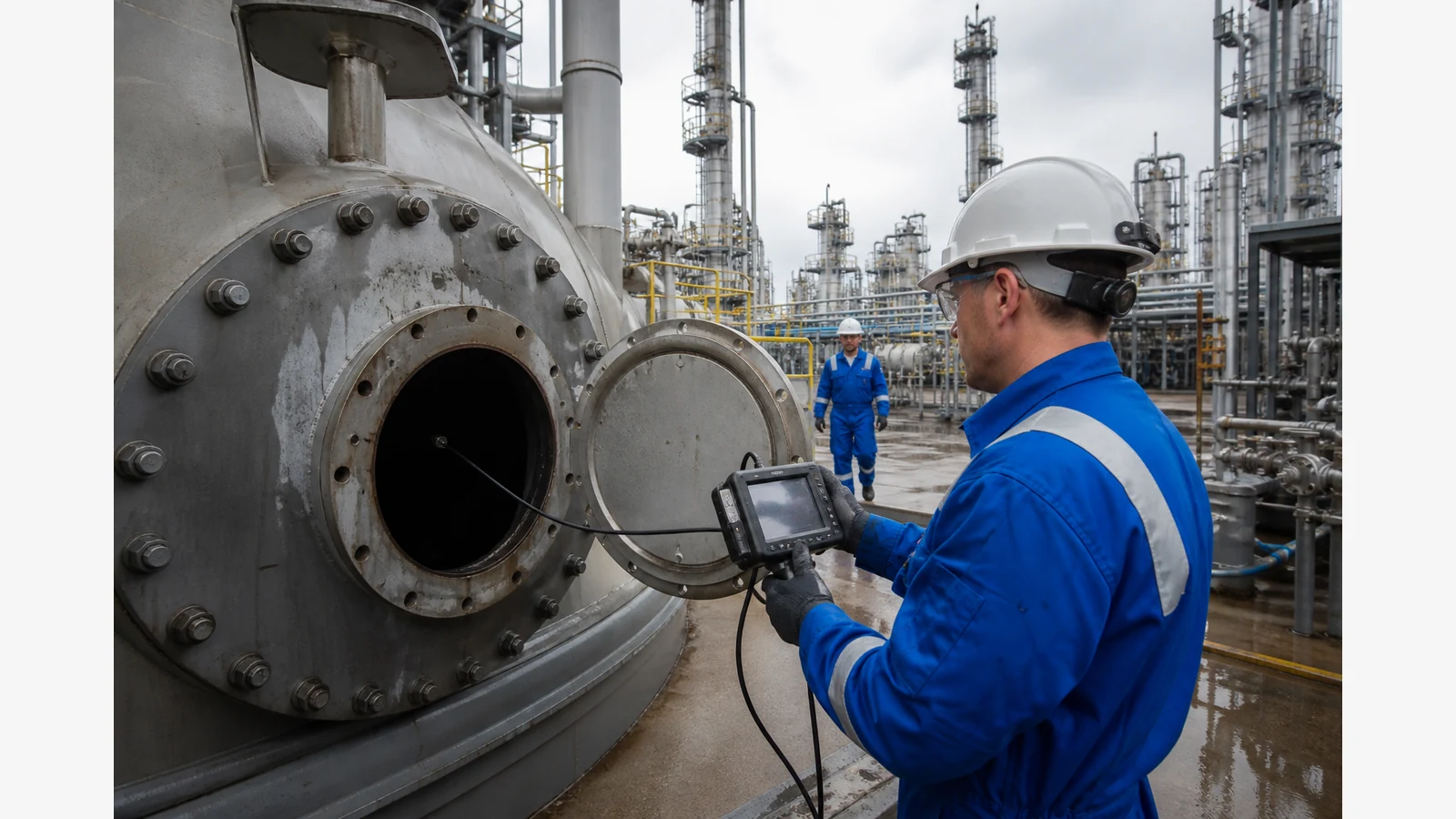
Remote Visual Inspection Camera Confined Spaces Uk
Under UK confined spaces practice, the first duty is to avoid entry when the work can be done from outside. Remote cameras and other remote visual inspection (RVI) methods are recognised tools for that strategy — but only when they can deliver the examination results and safeguards the job actually requires.
The Health and Safety Executive’s confined spaces Approved Code of Practice (L101) explains the Regulations framework for those who work in or manage confined spaces. Start from the official overview: HSE L101 Safe work in confined spaces.
What HSE brief guidance says about remote cameras
HSE’s shorter worker-facing leaflet states key duties: avoid entry where possible, follow a safe system of work if entry is unavoidable, and arrange emergency plans before work starts. Examples of doing work from outside include inspection and sampling with appropriate equipment, and using remote cameras for internal inspection of vessels.
Read the free leaflet: HSE INDG258 confined spaces brief guide (PDF).
Practical capability questions for dutyholders
- Can the camera reach every surface that the written scheme or risk assessment says must be seen?
- Can operators record stills or video that auditors can re-check later?
- Is lighting adjustable enough for reflective metal and dark voids?
- Does tip steering or dual viewing matter for the defect locations you expect?
- Have you documented when RVI is not adequate and entry remains necessary?
For equipment matching — diameter, length, steering — keep the buying decision separate from the legal duty. Useful trade framing sits in dual lens versus articulating tip and when 1.5 m semi-rigid is enough.
Limits: RVI is not automatic legal equivalence
A handheld inspection camera does not, by itself, prove confined-spaces compliance. Dutyholders still need a suitable risk assessment, competent people, and — where relevant — a written scheme that states whether remote methods provide the same results and safeguards as entry. Industry papers on pressure equipment RVI likewise stress documented process limits rather than gadget substitution.
Reader next action
Update the job’s risk assessment and examination procedure first. Choose camera capability only after the surfaces, access points and evidence standard are written down. This article is guidance to help that conversation; it is not legal advice.
FAQ
Does buying any articulating borescope satisfy the Confined Spaces Regulations?
No. The Regulations and ACOP concern safe systems of work and avoiding entry where reasonably practicable. Tools support that plan; they do not replace it.
Is a short 1.5 m handset enough for vessel RVI?
Only if the written examination scope fits that reach. Many vessels need longer or specialist RVI kits.