Evaporator Coil Back Face Camera Uk
Direct answer: to document evaporator coil back-face fouling, you need a probe slim enough for the access and a way to look sideways once the tip is in position. A fixed straight-ahead lens often shows the approach, not the fouling face.
Why coil backs catch out fixed cameras
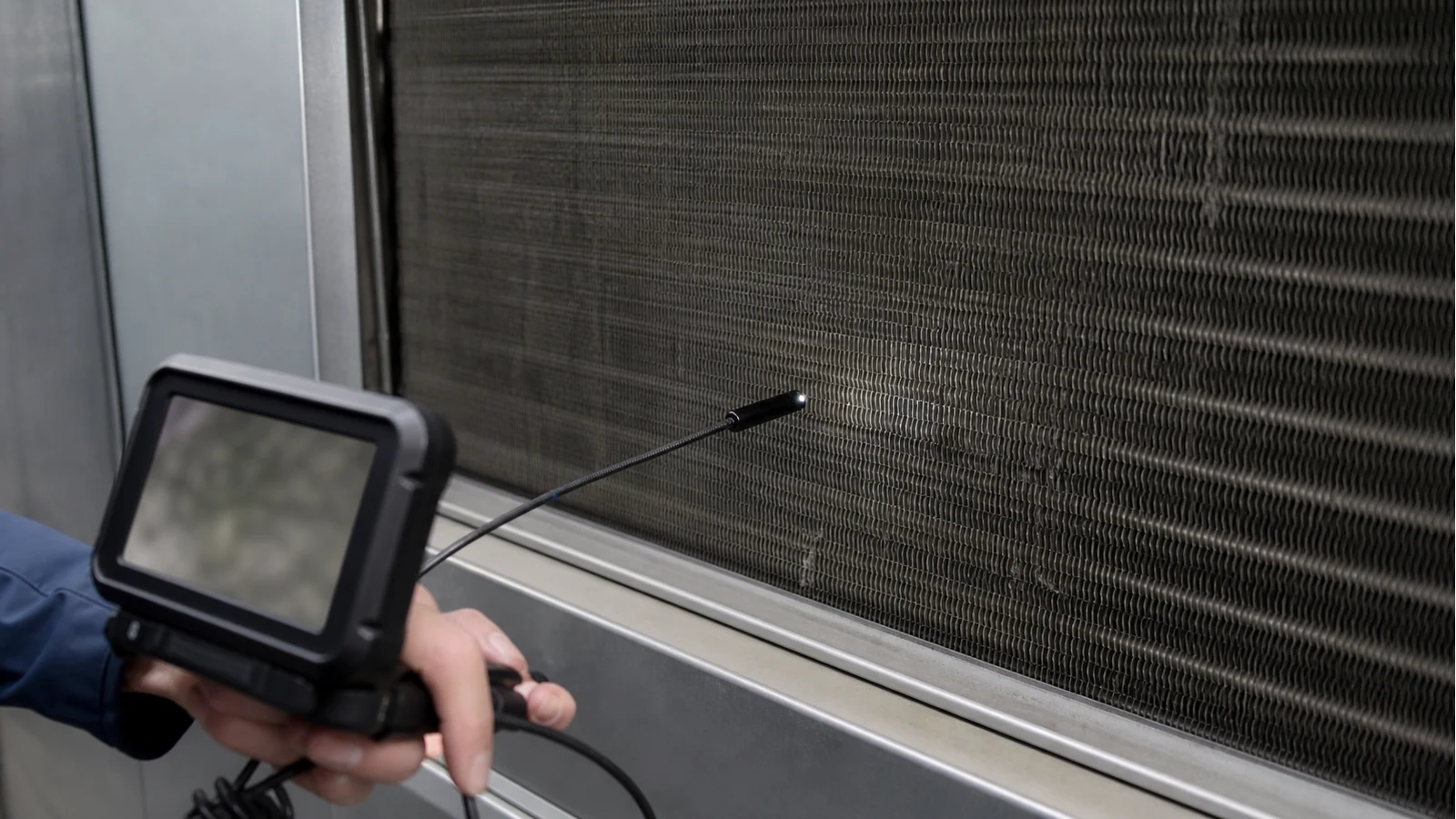
Coil inspections are awkward because the surface of interest is often not in front of the probe. A current HVAC borescope guide names coil back faces as a clear case where articulation matters because the fouling is on the far side of the viewing path. The access guidance is summarised in this HVAC borescope selection guide.
The decision starts with the coil and casing, not the camera catalogue. If the access panel is large and the far face can be seen directly, a standard camera may work. If you are threading between fins or through a small service opening, the probe diameter and the ability to turn the view become the controlling details.
Back-face documentation checklist
- Access point: record whether you used a panel, drilled inspection point or existing gap.
- Probe diameter: confirm the probe enters without spreading fins or scraping the coil.
- View type: note straight view, side lens, or steered tip.
- Cable control: check that the cable can be pushed and held without buckling.
- Photo set owner: decide whether images go to the FM, client, RFI response, snagging pack or maintenance record.
Side lens, steering, or both?
A side-view lens is useful when the probe can reach the back-face line and simply needs to look sideways. Tip steering is useful when the probe also has to negotiate a bend or hold an angle. Some trade products combine a compact head, a built-in screen and articulation; UK listings such as this articulating HVAC inspection camera listing show the sort of features buyers compare. Use those listings as a feature reference, not as proof that any one probe will fit your coil.
Where the inspection should stop
Stop if the probe needs force, if the coil fins are being distorted, if condensation or debris is smearing the lens so badly that the image is misleading, or if the camera view is being used to create a hygiene pass/fail threshold that has not been defined. A photo can document visible fouling; it does not replace the cleaning specification, commissioning requirement or client acceptance criteria.
This is also where the cheaper tool can be the better tool. If the only access is too tight for a steerable head, a smaller fixed probe may be more responsible than forcing a larger articulating one. Fit comes before features.
Make the photo pack useful
Take one context image of the AHU or coil bank, one image of the access route, then several internal images from repeatable angles. Keep the file names boring and descriptive: site, asset, date, access point and view. Avoid overprocessing images; the point is to let the client see what the technician saw.
If your next question is cable behaviour rather than coil access, compare the trade-offs in semi-rigid vs flexible borescope cable. If the job is a heat exchanger rather than a coil, the limits are covered in heat exchanger inspection camera UK.
Bottom line
Proceed when the probe fits freely, the viewing direction reaches the back face, and the captured images answer a real maintenance or handover question. Do not proceed when the camera is likely to damage fins, when the opening is too small, or when the photo is being treated as a formal cleanliness verdict without agreed criteria.