Semi Rigid Vs Flexible Borescope Cable Uk
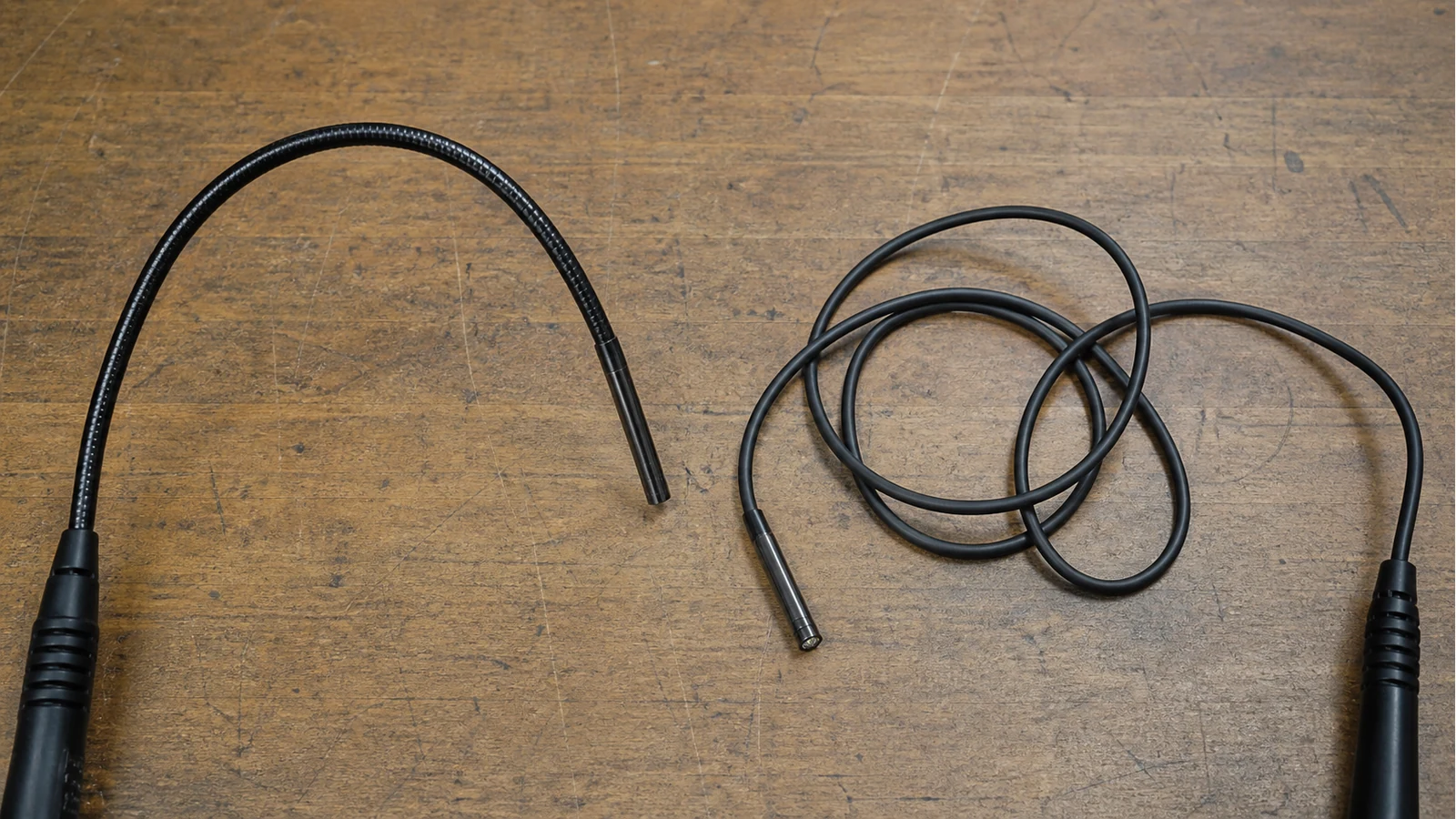
Direct answer: choose a semi-rigid borescope cable when you must push along a short horizontal run and hold a shape. Choose a very flexible cable when the path has tight bends and gravity or the pipe route will guide the probe.
Pushability beats advertised length
A longer cable is not automatically more useful. HVAC buying guidance notes that very flexible cables can buckle when pushed horizontally, while semi-rigid cables hold shape better but do not follow tight bends as easily. The practical trade-off is explained in this HVAC cable stiffness guidance.
For UK short-run work - engine bays, shallow wall voids, plant-room elbows and coil access - control often matters more than metres. A 1.5 m cable you can place accurately may beat a much longer cable that coils in the first bend.
Decision table
| Inspection path | Better starting point | Why |
|---|---|---|
| Horizontal void or shallow duct elbow | Semi-rigid | Holds a curve and can be pushed without collapsing immediately |
| Tight S-bend or trap | Flexible | More likely to follow the bend without fighting the wall |
| Engine plug port to nearby crown or wall | Semi-rigid or steerable short probe | Fine positioning matters more than long reach |
| Long drain CCTV run | Neither short borescope class | Use a proper drain camera reel, not a short inspection scope |
| Off-axis target after access | Semi-rigid plus side view or steering | The cable places the tip; the viewing method turns the image |
Do not force the probe
Forcing a semi-rigid cable around a bend can kink the cable or damage the probe head. Forcing a soft cable down a horizontal void usually wastes time because it buckles. The right technique is to test the first 20-30 cm, observe how the cable behaves, then decide whether to continue, withdraw, or switch tool class.
General borescope buying advice makes the same point: match reach and cable behaviour to the job instead of buying the largest number on the listing. See QBH's guide to matching probe size, reach and steering.
Image quality still matters, but later
Once the probe reaches the target, lighting and capture quality decide whether the image is useful. InspectandTest's guide to reading borescope specifications warns that resolution claims do not tell the whole story; lighting, optics and file output affect whether close-range detail is usable. The plain-language breakdown is here: borescope camera spec guide.
Who should not buy semi-rigid
If your main work is long drain runs, repeated tight traps, or routes where the cable must snake freely with little push force, a semi-rigid short-run scope is the wrong class. If your work is mainly shallow access with a need to hold angle and view sidewalls, it becomes much more sensible.
For specific engine-access limits, see glow-plug hole borescope size checklist. For site workflow rather than cable behaviour, compare built-in screen vs phone app borescopes.
Bottom line
Pick cable stiffness for the path. Semi-rigid is a placement tool for controlled short runs. Flexible is a following tool for tighter bends. Neither replaces a proper long-reach drain camera when the job is measured in tens of metres.